Sunday, 29 November 2015

Fisheries

Fisheries
Fisheries can be divided into two term where it is done through capture of wild fish or culturing fishes by aquafarming. In this topic we are going to discuss about fisheries in aquafarming, fishes is reared and harvested when matured to be commercialise to market. The increase of food demand worldwide had cause overfishing in the ocean which will eventually cause the extinction of fish species so the idea of culturing fishes is done to sustain life and fulfil the requirement of food in the world. With fishery aquafarming, many types of fish can be cultured and marketed for their high value and low cost to sustain the culture process.

Aquaculture
Aquaculture is the farming of aquatic plant and animal which involves cultivating freshwater and saltwater populations under controlled conditions, and can be contrasted with commercial fishing, which is the harvesting of wild fish. Mariculture is also included in aquaculture it refers to aquaculture practice in marine environments and in underwater habitat. It is necessary to improve nutrition and food security and to supply growing global demand for seafood, which can’t be met by wild fisheries. There many ways aquatic species can be cultured and below are some of the methods used in culturing different types of fishes.

Open-net pen systems
The system is cultured in the natural habitat of the fishes and is usually used offshore in coastal areas or in freshwater lakes, open-net pens or ‘cages’ are considered a high-risk aquaculture method as they allow for free and unregulated exchange between the farm and the surrounding environment. Farmed salmon are one of the example that can be farmed in this manner. Open net pens system have low cost in sustaining the farm needs as it does not require any management in the water system. Disadvantages of this system is that there is a free exchange of high concentrations of waste, chemicals, parasites and disease that could cause. Possibility is high for the farmed fish to escape and they also attract predators, such as marine mammals, that can get tangled and drown in fish farm nets. It is not a recommended aquaculture method to sustain life as it disturb the aquatic life found in the cultured area and also brings danger to the cultured fish.

Closed Systems
Closed systems or ‘closed containment’ is the improved aquaculture method of open-net system where the farming methods use a barrier to control the exchange between farms and the natural environment. This significantly reduces pollution, fish escapes, negative wildlife interactions, and parasite and disease transfer from farms to marine and freshwater ecosystems.

Raceways
Flowing water is diverted from natural streams or a well. Raceways are typically used for raising rainbow trout. To be considered a low-risk method, waste must be treated and fish escapes prevented.


Recirculation systems
 Known as RAS, the water in these systems is treated and re-circulated to be reused. Most used method in aquaculture and almost any type of finfish can be raised in recirculating systems. Common species farmed in this manner include Arctic char, striped bass, barramundi, sturgeon, and increasingly salmon. This system does not mix with natural water sources, which is able to prevent problems and risk such as mitigates pollution, parasite transfer, fishes escape or being targeted by predator. This is the most efficient method as compared to other aquaculture method with optimum yield and low cost however the starting of the cost is quite expensive but maintenance cost is reliably cheap. 


Suspended-aquaculture
Farmers grow shellfish on beaches or suspend them in water by ropes, plastic trays or mesh bags. The shellfish farmed using these methods are filter feeders and require only clean water to thrive. Oysters, mussels and clams are cultured using suspension systems. Shellfish farming using this method is often ‘low risk’ if the farmed species is native to the area and if the farm has sufficient flow to prevent waste accumulation.


Aquatic plants
Cultivating emergent aquatic
plants in floating containers.


Algaculture the culture of microalgae referred to as phytoplankton, microphytes, or planktonic algae constitute the majority of cultivated algae. Seaweed farming is known as macroalgae have many commercial and industrial uses, but due to their size and specific requirements, they are not easily cultivated on a large scale and are most often taken in the wild. Culturing of aquatic plant require a lot of consideration into the environment suitability for the plant. Growing algae needs water, carbon dioxide, minerals and light are the main important factor and other factor such as temperature, light and mixing, odor and oxygen, and nutrients.

Fish
The farming of fish is the most common form of aquaculture. It involves raising fish commercially in tanks, ponds, or ocean enclosures, usually for food. A facility that releases juvenile fish into the wild for recreational fishing or to supplement a species' natural numbers is generally referred to as a fish hatchery. Worldwide, the most important fish species used in fish farming are, in order, carp, salmon, tilapia and catfish.
In the Mediterranean, young bluefin tuna are netted at sea and towed slowly towards the shore. They are then interned in offshore pens where they are further grown for the market. In 2009, researchers in Australia managed for the first time to coax tuna (Southern bluefin) to breed in landlocked tanks.
A similar process is used in the salmon farming section of this industry; juveniles are taken from hatcheries and a variety of methods are used to aid them in their maturation. For example, as stated above, one of the most important fish species in the industry, the salmon, can be grown using a cage system. This is done by having netted cages, preferably in open water that has a strong flow, and feeding the salmon a special food mixture that will aid in their growth. This process allows for year-round growth of the fish, and thus a higher harvest during the correct seasons.

Crustaceans
Crustacean are aquatic animal with shells like crabs, crayfish, prawn, and shrimp. Shrimp farming has been group into 2 category, marine shrimp farming and freshwater prawn farming. Shrimp farming has changed from its traditional, small-scale form in Southeast Asia into a global industry. Technological advances have led to ever higher densities with broodstock is shipped worldwide. Virtually all farmed shrimp are penaeids from the family Penaeidae, and just two species of shrimp, the Pacific white shrimp and the giant tiger prawn, account for about 80% of all farmed shrimp.
Freshwater prawn farming shares many characteristics with, including many problems with, marine shrimp farming. Unique problems are introduced by the developmental life cycle of the main species, the giant river prawn.

Molluscs
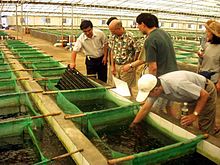
Abalone farm


Aquaculture shellfish include various oyster, mussel and clam species. These bivalves are filter and/or deposit feeders, which rely on ambient primary production rather than inputs of fish or other feed. As such shellfish aquaculture is generally perceived as benign or even beneficial. Depending on the species and local conditions, bivalve molluscs are either grown on the beach, on longlines, or suspended from rafts and harvested by hand or by dredging. Over-fishing and poaching have reduced wild populations to the extent that farmed abalone now supplies most abalone meat. 

Tuesday, 27 October 2015

SLASH AND BURN FARMING IS A BAD FARMING PRACTICE

WHAT IS SLASH AND BURN FARMING?


Slash and burn farming is a form of shifting agriculture where the natural vegetation is cut down and burned as a method of clearing the land for cultivation, and then, when the plot becomes infertile, the farmer moves to a new fresh plot and does the same again.  This process is repeated over and over.


Negative Aspects of Slash and Burn

Many critics claim that slash and burn agriculture contributes to a number of reoccurring problems specific to the environment. They include:
  • Deforestation: When practiced by large populations, or when fields are not given sufficient time for vegetation to grow back, there is a temporary or permanent loss of forest cover.
  • Erosion: When fields are slashed, burned, and cultivated next to each other in rapid succession, roots and temporary water storages are lost and unable to prevent nutrients from leaving the area permanently.
  • Nutrient Loss: For the same reasons, fields may gradually lose the fertility they once had. The result may be desertification, a situation in which land is infertile and unable to support growth of any kind.
  • Biodiversity Loss: When plots of land area cleared, the various plants and animals that lived there are swept away. If a particular area is the only one that holds a particular species, slashing and burning could result in extinction for that species. Because slash and burn agriculture is often practiced in tropical regions where biodiversity is extremely high, endangerment and extinction may be magnified.
The negative aspects above are interconnected, and when one happens, typically another happens also. These issues may come about because of irresponsible practices of slash and burn agriculture by a large amount of people. Knowledge of the ecosystem of the area and agricultural skills could prove very helpful in the safe, sustainable use of slash and burn agriculture.

Sustainable Agriculture


What Is Sustainable Agriculture?

Sustainable agriculture is the production of food, materials, or animals using farming techniques that preserve the environment for future use. With the population of the Earth growing explosively and the available resources being rapidly consumed, it has become imperative for farmers to consider the practices of sustainable agriculture. Without consideration for the future of the environment, the world could very soon enter a food crisis.

What Are the Benefits of Sustainable Agriculture?

Sustainable agriculture seeks to eliminate all of the aforementioned problems. Pesticides, fertilizers, and artificial growth hormones are eliminated entirely from agricultural production. Therefore, the food produced has no risk of harming the consumer and does not contribute to any chemicals in the water or air supply.
Further, whereas the typical farm is a single crop farm, sustainable agriculture often raises more than one crop or product on a single farm. This allows crop rotation to take place, wherein one crop can renew the nutrients that another has taken up in the previous season. Also, livestock on the farm can be used to naturally fertilize the soil. This method of rotation ensures the health of the environment each year for further use. Non-sustainable farming, on the other hand, simply uses the land until it has nothing left to give.
Water is also managed sustainably, with research being done to ensure that water is not being used faster than it is renewed at the source. This often means fewer farming plots in an area or simply a highly-efficient water system such as drip irrigation. Sustainable farmers plant only those types of plants that naturally thrive in their area’s climate so that the crops are more likely to thrive from what the earth can produce rather than what a farmer can provide the crop.
Finally, animals are allowed to live outside and are fed by the land they graze upon. They are allowed to build healthy muscles through exercise and do not accumulate any genetically modified substances or growth hormones in their systems. This ensures their natural growth, leading to meat that is safe for humans to consume.


Palm oil plantation in Malaysia

Palm oil plantation in Malaysia


Introduction of oil palm plant and palm oil

Many people understand that oil palm produces the common vegetable oil used in our daily products but few ask about where the oil is derived from. Palm oil ( dendĂȘ oil, from Portuguese) is an edible vegetable oil derived from the mesocarp of the fruits bear by the oil palm tree. Yes oil palm and palm oil is a different thing, oil palm is the plant itself and palm oil is the vegetable oil it produces. Oil palm tree took around 30 months to grow from a baby plant to adult and starts to bear fruits afterwards, the lifespan of an oil palm tree is estimated to be able to live for 20 to 30 years and remain productive.  The oil palm tree are used in commercial agriculture in the production of palm oil since palm oil contains more saturated fats than oils made from canola, corn, linseed, soybeans, safflower, and sunflowers, it can withstand extreme deep-frying heat and resists oxidation. It also contains no trans-fat. Many country in the world begins to largely commercialize oil palm plantation mainly in Malaysia and Indonesia because of the advantage of the palm oil it produces.

History of palm oil plantation in Malaysia.

Oil palm species Elaeis guineensis was first introduced into Malaysia as an ornamental plant in the 1870s. Since 1960s, Malaysia had started to widely commercialize the palm oil plantation and rapid increase of area used for palm oil plantation to replace rubber plantation as the market price for rubber is declining further. In 1985, the total area planted for palm oil is 1.5 million hectares which then increased to 4.85 million hectares of palm oil plantation in 2007. As of 2011, the total planted area increased to 4.971 million hectares. Malaysia was known to be the 2nd largest palm oil producer in the world after Indonesia. Currently Malaysia uses oil palm tree of tenera hybrid which gives better yield yearly as compare to the previous species. The advantage of using Tenera hybrid was the fruits of oil palm can be fully utilize with reduce wastage thus is more environmentally friendly


Malaysia government had plan to make palm oil plantation the country main source of income and to replace the rubber plantation production. In the 1960s, a  land settlement scheme plan is introduced for planting oil palm in smallholder( small farmland for own uses) to eradicate the poverty for smallholder farmers. Palm oil fetch a high price in the market and are encourage by the government to help increase in the land used for palm oil plantation.  Nowadays Malaysia palm oil plantation are largely based on estate area and smallholder

The palm fruit is about the size of a small plum and borne in large bunches. The cross-sectional area of the fruits of oil palm showing the mesocarp and the kernel. Mesocarp produces the palm oil while the kernel is of no value. However with nowadays technology, the kernel is utilize and process into livestock feeds so that there is no wastage produced.


Sperm Cryopreservation of Some Freshwater Fish Species in Malaysia

Sperm Cryopreservation of Some Freshwater Fish Species in Malaysia 

Ex Situ Conservation Methods
Ex-situ conservation is the preservation of components of biological diversity outside their natural habitats.  This involves conservation of genetic resources, as well as wild and cultivated or species, and draws on a diverse body of techniques and facilities.  Gene banks, e.g. seed banks, sperm and ova banks. 

Cryopreservation of fish semen and considering Malaysia has a rich fish fauna with many of them unique to this tropical region, cryopreservation of fish gametes will require detailed study to create new protocol for each fish species intended for semen cryopreservation. To date in Malaysia semen cryopreservation has only been reported for several freshwater fish species, namely Probarbus jullieni, Tor tambroides, T. deuronensis, Hemibagrus nemurus, Pangasius nasutus, Hypsibarbus wetmorei, Barbonymus gonionotus and Clarias gariepinus. It has been demonstrated that semen cryoperservation plays an important role for the genetic conservation of these fish species. 


Cryopreservation technology for fish semen is still not well explored in Malaysia and can be considered as new if compared to the domesticated terrestrial livestocks. Henceforth, this has opened up a new field to be explored with potential applications in aquaculture and in the conservation of the national fisheries genetic resources. Cryopreserved semen could facilitate artificial fertilization especially when mature male fishes are not available or unable to provide viable semen during certain periods of the breeding season. Semen cryopreservation may also be useful for fertilization to produce hybrids of various fish species. It also helps in reducing the cost and labor of maintaining broodstocks under in situ condition. In line with the mission of Department of Fisheries (DOF) Malaysia to develop and manage the national fisheries sector in a sustainable manner, the gene bank of freshwater fishes in the form of semen cryobank of Fisheries Research Institute at Glami Lemi was established in 2008. The establishment of the semen cryobank research has achieved the aim of the DOF towards establishing a national semen cryobank (gene bank) in Malaysia for conserving the genetic materials of the threatened or endangered indigenous freshwater fish species and also for those indigenous species which has potential for aquaculture.

An overview of the current status of semen cryopreservation of Malaysian freshwater fishes is presented in this chapter. The role of semen cryobank is also discussed. Obviously, semen cryopreservation offers potential applications in ex situ conservation and sustainable management of the fisheries genetic resources in Malaysia, especially for those species with rare, vulnerable, threatened or endangered status, those protandry species with sexchanging characteristic over their life time, and also the potential candidates and genetic improved strains for aquaculture development. The successes in semen cryopreservation are very much relied on factors such as having ample knowledge on the biology and reproductive biology of the particular species of interest, trained personnels in various aspects such as gamete cryopreservation, breeding methods, broodstock management and husbandry and larva rearing and nursing of the targeted species.


Monday, 5 October 2015

Summarize the agricultural problem in Peru

Summarize the agricultural problem in Peru

There is a change in climate at commonwealth of Yacus which causes a problem in their agricultural activities. Peru are very dependently on water resources to continue their agricultural activities, now with the lack of water resources the villager had to delay their time of planting potatoes which was previously planted from September and October which was then postpone to November and December. Besides the problem of water irrigation, Peru also faces the problem of humidity. Due to potatoes are suitable only to grow in humid zone the villager had to plant at a higher altitude up to 13,000 and 14,000 feet as the soil erosion below is strong. Their problem is at lower altitude, there isn’t much humidity and organic material to hold onto the little rain that falls. With the hope of breaking soil at higher altitude for potatoes plantation however they are not sure of the type of soil, climate and pasture are really suitable for their potatoes plantation so as to prevent any lost of their variety of potatoes.
In Peru, there is no proper guidance given to the villager for agriculture activities which has cause an unnecessary use of chemical and fertiliser for the crop. The seeds for crop production is not suitable for the soil in Peru so they are in search of new seeds for agriculture production. The people also faces problem of selling their products, the organic grown crop without any use of chemical and insecticides are rejected by buyer at the market because of the different appearance compare to products which uses fertiliser as it looks more reliable by most buyer. In the central sierra, most of the land are dry. They don’t have any infrastructure for irrigation of water at Mantaro Valley.

Discuss how to solve the problem
Firstly, Peru have water resource problem which can be solve by having a better water irrigation system as it is important for agricultural activities. The villager can begin by storing a large amount of water supply when water is available specially kept for agricultural uses as they mention water supply are scarce for agriculture activities. Second problem was humidity due to the increase in the temperature, humidity at lower altitude was lower. Besides planting the potatoes at higher altitude which can be a risk as the soil and environment condition was unknown, the villagers can opt for a greenhouse built for potatoes plantation. Greenhouse are able to control the environment of the surrounding inside whichever condition are suitable for the people in Peru to plant their potatoes and greenhouse also have an advantage where it is able to produce the environment for the climate of 4 seasons. With the use of greenhouse, plantation for potaotes will not be delayed and can be planted throughout the year. Third problem was that the Peru people does not have any understanding about farming and agricultural education plus they didn’t realize that their soil was actually fertile and does not require any fertiliser at all. They should look for the help from government to govern the farmer and done a proper examination on the ground soil at Peru. The farmer should be educated about importance of agriculture and the side effect of using too much fertiliser. Farmers should also get new types of seeds with GMOs that have better traits and gives higher yield for agriculture, which where they will be selling at the market. They should promote their healthy products to buyers so that they know how their products were grown as compared to those uses fertiliser and insecticides. The problem with irrigation of water can be solve by seeking help from the government of Peru about the problem lack of water irrigation for agricultural purpose.

Monday, 28 September 2015

Genetically Improved Farmed Tilapia (GIFT)


Genetically Improved Farmed Tilapia (GIFT)

Benefits for the developing world
Faster-growing, hardier and more disease-resistant fish have numerous benefits for smallscale farmers and resource-poor consumers. They allow farmers a greater return on their investment, and in some countries genetically improved tilapia has increased the national production rate of tilapia and led to lower prices for consumers.


The success of GIFT and GIFT technologies
A study by the Asian Development Bank found that in 2003, GIFT and GIFT-derived strains accounted for 68% of tilapia production in the Philippines, 46% in Thailand and 17% in Vietnam.
 In 2010, a sample survey in Bangladesh found that 75% of mono-sex tilapia hatcheries exclusively used GIFT as their brood stock.

 The selective breeding methodology developed through the GIFT project, known as“GIFT technology,”has also been successfully applied to Nile tilapia and other tilapia species in Egypt, Ghana and Malawi, as well as to other fish species, including carp. 

In Egypt, the second-largest tilapia-producing country in the world, the Abbassa strain of Nile tilapia developed by WorldFish grows up to 28% faster than the most commonly used commercial breed in the country. The improved strain was disseminated to Egyptian hatcheries in 2012 and is expected to have significant economic benefits for the country’s booming aquaculture industry

Thursday, 17 September 2015

Commercialise farming of Mushroom

Commercialise farming of Mushroom


Many often mistaken mushroom to be a vegetable because it is edible same as plant but they are actually not. Mushroom are categorize as fungus that grows on any medium without the need of soil. They are heterotroph, meaning they acquire food by absorbing dissolve nutrients from the environment it is growing on. Mushroom nowadays are commercialise for profit. There are over 2000 types of mushroom which are edible worldwide. Some mushroom that are used in commercial are common button Agaricus. Some other varieties of agaricus are “Shiittake, Oyster, Wood ear and Enoki mushrooms which have a higher demand in the market.


Commercialise farming of mushroom are valuable in the market. It does not require a soil as a medium however it grows in specially constructed buildings which meet the suitable condition for cultivation of mushroom. Mushroom are grown in controlled environment(temperature and humidity). Cultivated mushroom are usually grown in the dark in climate-controlled rooms. The fungal inoculum or spawn is added to a pasteurised substrate in the growing containers or beds. After fungal strands(mycelia) have spread through the compost, a layer of peat or soil(the casing) is added. The fruiting bodies begin appearing about 6 weeks after spawning and continue appearing in flushes about 7-10 days apart from the next 6-8 weeks. The first 3 flushes are the most productive. The cap and a small section of connected stem are usually harvested before the caps are fully expanded.

Mushroom is harvested through by hand. As mushroom easily deteriorate, they are marketed as soon after harvesting and should be well kept in suitable environment under cold temperature. Mushroom yield are influenced by compost depth and quality, length of cropping and grade of mushrooms picked, spawn productivity, moisture and climatic conditions and disease factors. The mushroom will be picked after the first 3 flushes at about 4 weeks.

The benefit of mushroom cultivation are that it does not take up any land spaces as it is cultivated using specially contructed building with some that are from idle buildings. Mushroom production that are available throughout the year provide farmer a stable income annually. Cultivation of mushroom uses substrate produce from agricultural waste material from the farms, plantation and factory which gets all its nutrients from the substrate. Mushroom cultivation does not require any spray of pesticide which makes them free from toxic substance and suitable for consuming.

Challenges in Mushroom Growing are the lack of skills on mushroom production knowledge, spawn and raw material for mushroom cultivation is expensive and the quality are not guaranteed, lack of awareness of benefits of mushroom, Traditional beliefs of some communities.

How mushroom is cultivated, harvested and package for marketing